
Stop launching initiatives. Start building infrastructure.
Jun 22, 2026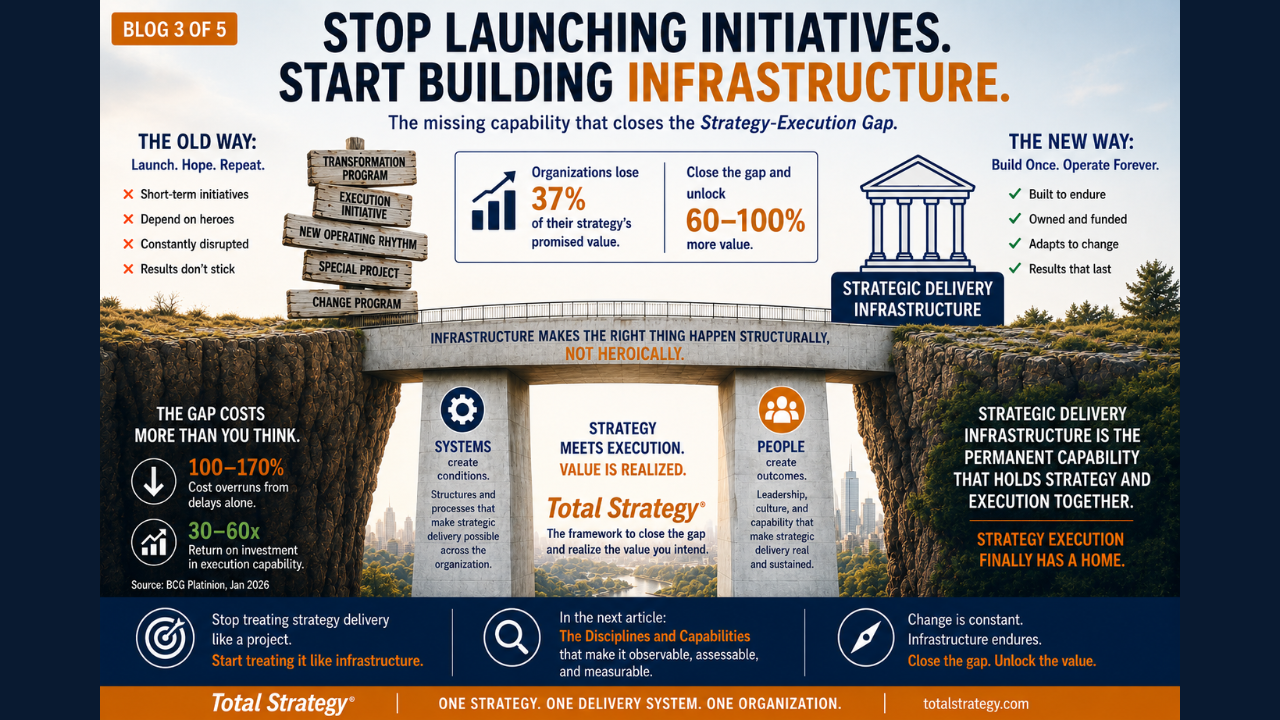
So far in this series I have made two claims. First, your strategy is not the problem; the 37 percent of value most companies lose leaks out through the Strategy-Execution Gap. Second, the SEG is specific: three dimensions where the leaking happens, and three conditions that describe where your organization stands against it.
Before the answer, here is what is at stake. The same research that measured the 37 percent loss also measured the prize. Organizations that realize the full potential of their strategy can increase their value by 60 to 100 percent. Read that again. For most organizations this is the single largest source of untapped value they own, and it is sitting inside work they have already approved and funded. Nobody has to invent it. It just has to stop leaking.
This article is about how. And I want to start with the word that took me the longest to find, because the word is the whole idea.
Infrastructure.
Think about what your organization does when the strategy is not landing. It launches something. A transformation program. An execution initiative. A new operating rhythm with a name and a kickoff deck. Every one of those is a project, and projects share one defining feature. They end. The program wraps, the consultants leave, the sponsor moves on, and eighteen months later someone is writing the deck for the next launch.
Now think about what your organization never launches. Nobody runs a twelve-month initiative to have financial controls and then declares victory and shuts it down. Nobody sunsets the HR system because the sponsor changed roles. Finance, legal, IT security, payroll. These are not initiatives. They are infrastructure. They exist permanently, they are owned, they are funded as a cost of doing business, and no one has to re-justify them every budget cycle.
I remember attending a client All-Hands meeting. 150+ employees stuffed into a large open space the CEO sharing the new Strategic Plan with the organization. I was in the back taking it all in and listened as a couple of employees started talking, “Here we go again. Another shoot-the-moon project that disappears in a few months”. I was a bit stunned to hear their immediate indifference to the new plan. While building Total Strategy what I realized is that change within an organization is constant and disruptive. What didn’t change were the structures. People change. Priorities change. Budgets change. Infrastructure remains. In many ways, infrastructure is the organization.
Here is the question that changed how I think about all of this. Why does every other critical capability in the enterprise get treated as infrastructure, while the capability of delivering your strategy gets treated as a project?
That question is what Total Strategy answers. It is not a methodology you adopt or a program you run. It is Strategic Delivery Infrastructure: the permanent organizational capability that holds strategy and execution together. You build it once, you operate it forever, and it does for strategy delivery what your financial controls do for money. It makes the right thing happen structurally instead of heroically.
So what does this infrastructure consist of? It stands on two foundations, and the pairing matters more than either half.
Systems create conditions. The structural half. This is the mandate that makes strategic delivery legitimate, the intake that keeps operational work from flooding the strategic portfolio, the cadence that keeps decisions flowing, the visibility that shows what is actually happening rather than what sponsors report. Systems are what carry strategic work across functional boundaries so it does not depend on two leaders being friends.
People create outcomes. The human half. The candor that lets bad news travel fast enough to act on. The empowerment that lets decisions happen where the work happens. The competence, development, and identity that make strategic delivery something your people are rather than something they are assigned to. Systems without people produce beautiful process that delivers nothing. People without systems produce heroes who burn out.
Foundations alone are not enough. The infrastructure must be visible. When we see HR, Finance, or IT, we know what capabilities they provide. Strategic Delivery Infrastructure should be no different. It must be observable, assessable, and measurable. That is where the Disciplines and Capabilities come in, and that is where we will go next.
Compare this to what we see on almost every engagement we take on. It usually starts like this, “We’re a level 2 PMO and are trying to get to level 4 by the end of next year. Can you help us?” My first question is, How do you know you are level 2? Who scored that for you? These scores are maturity scores. They measure one question: are you better? As you progress you feel like improvement is making a difference. What these organizations are not measuring: are you capable? Maturity is not bad, but it is what fuels the CEO to share, “yes, we’ve gotten better but we’re just better at not being good enough.”
And the business case for building it is now measurable. In January 2026, BCG Platinion published a study of large-scale technology programs with two findings every CFO should read together. Project delays alone inflate costs by 100 to 170 percent of the original investment. And investing just 3 to 5 percent of program budget in structured execution capability yields a 30 to 60 times return. Sit with that pairing for a second. The most expensive option on the table is the one most organizations choose by default: keep launching programs without the infrastructure underneath them. The math on closing the gap is not complicated. The will to build the system that closes it is what has been missing.
In the next article, I am going to take on the obvious objection. If this is the answer, why do PMOs and transformation offices keep failing at it? The answer is not what most PMO leaders want to hear, but it is something every one of them has felt.
Strategy execution finally has a home.
Want the full architecture? Access the complete Total Strategy structure on The PMO Squad website.
Follow Us on LinkedIn