
The Strategy-Execution Gap
Jun 17, 2026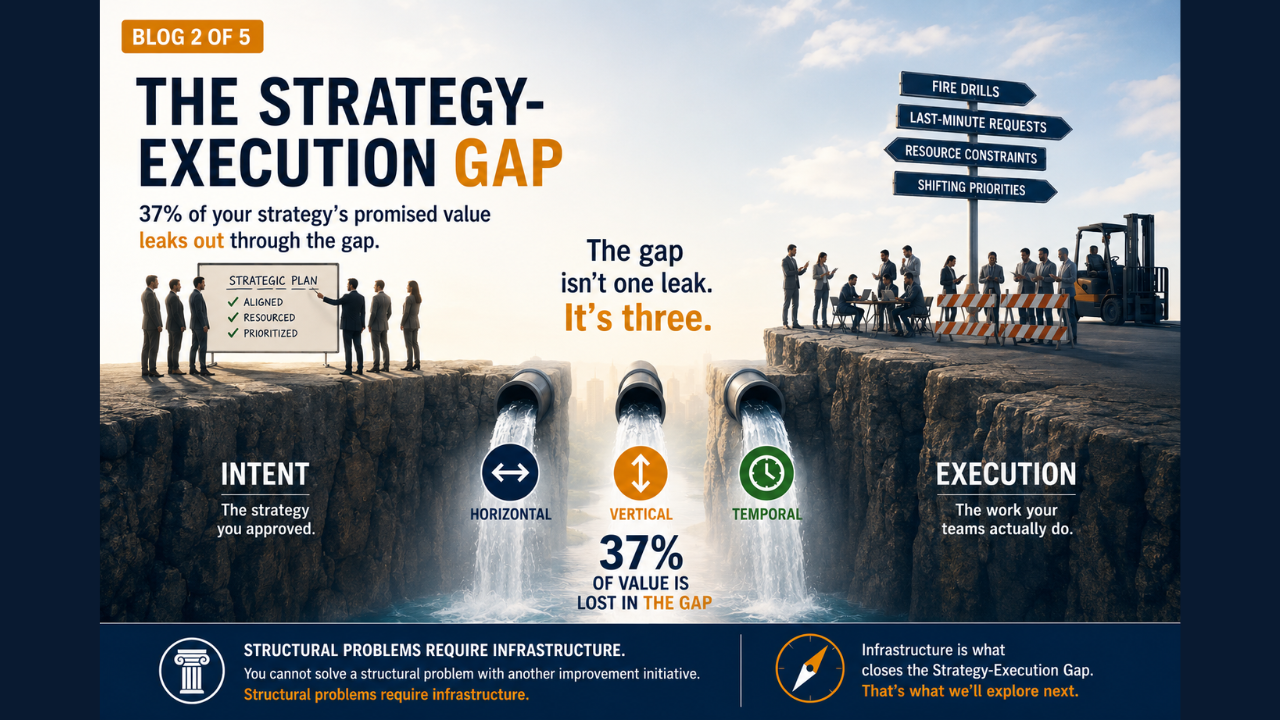
In the first article of this series I made a claim. Your strategy is not the problem. The problem is the gap between the strategy you approved and the work your organization actually does. That gap has a name. It is the Strategy-Execution Gap, and research says about 37 percent of your strategy's promised value leaks out through it.
Knowing the Strategy-Execution Gap exists is a start. But you cannot fix a leak until you find where it is leaking. This article answers the question every executive should ask next: where, exactly, does the value leak out? Like most leaks, this one isn’t easy to find. Many have tried but I’ve not yet found any research, article, framework, anything, that says they’ve found it and then offer the fix. Now, after 25 years of feeling it and searching for it, I can tell you it’s actually three leaks not one, and every failed initiative I have ever examined traces back to at least one of them. Once you know the three, you will start spotting them in your own organization almost instantly.
Like most professional services firms we start with discovery work to identify the root cause of our client’s troubles. I revisited these discovery sessions in search of the hidden treasure. The CFO at a regional manufacturing organization questioned why departments were spending on unauthorized work. The healthcare executive shared with me his frustration that team members were unaware of strategy. A PMO leader complained about operations stealing resources from strategic initiatives. The stories started lining up into 3 distinct categories. We had been searching for a single root cause when in fact there were three culprits causing the Strategy-Execution Gap.
The first leak point is Horizontal. Strategy crosses functional boundaries. Your org chart does not. When strategic work has to move between sales and operations, or between IT and Finance, it either advances because the system carries it or because two leaders personally negotiated it. In most organizations it is the negotiation. Which means the work moves at the speed of relationships, and stalls the moment one of those relationships changes. If you have ever watched an initiative die in the handoff between two departments that both swore they were committed to it, you have seen the Horizontal gap.
The second leak point is Vertical. Strategy is set at the top of the organization and delivered at all levels. Communication between the multiple altitudes results in message erosion. It’s the childhood telephone game playing out in real life. The executive team articulates a clear strategy. By the time it reaches the people doing the work, it has been translated through three or four layers, and what arrives is barely recognizable. The team is working hard. They are just working hard on something that is no longer quite the strategy. If your dashboards say everything is on track while your gut says the strategy is not happening, you have seen the Vertical gap.
The third leak point is Temporal. This one was the hardest to find, but most common in practice. It’s almost as if it knows it’s been sought and wears many disguises to avoid detection. Strategic work and operational work compete for the same people, the same budget, and the same attention. Operations always wins, because operations is urgent and strategy is merely important. A customer emergency arrives, strategic work gets paused, and the pause quietly becomes permanent. Every operational cycle pushes the strategic work a little further behind. If your most important initiative has been ninety days from its next milestone for the past year, you have seen the Temporal gap.
Three leak points. Across functions, down the altitudes, and over time. These are the three dimensions of the Strategy-Execution Gap: Horizontal, Vertical, and Temporal. And here is why naming all three matters. Most fixes organizations buy plug exactly one. A portfolio tool gives you vertical visibility and does nothing for the customer emergency that just stole your delivery team. A cross-functional steering committee helps horizontally and does nothing for the intent that degrades on its way down. The Strategy-Execution Gap leaks in three places and the insufficient fixes plug only one. That mismatch is why the fixes keep failing, and why the water keeps rising.
Bain reported in 2024, 88% of transformation initiatives failed to meet their original ambitions. Now consider our finding of a 3D Strategy-Execution Gap. If you close one, you think you are better. If you then work the next year to close another you think you are better. Can you even find the third dimension and get approval for another investment in year 3? I can understand the 88% when you consider the full scope of the three dimensions.
In the first article I mentioned the company who invested close to $1 million trying to fix delivery across the organization. In the first interview we conducted a VP shared her frustration with IT because the team was so fixated on customer outages. Her initiative was stalled because there was always an outage! We asked a project team why they were working on the technology project and they said it was a standard system upgrade. The Executive Sponsor shared the upgrade would finally allow a capability the team needed to expand to a new territory and increase sales. There was investment to get better, but better still wasn’t good enough for the CEO.
The dimensions are half the picture. The other half is where your organization stands against the Strategy-Execution Gap, and after enough assessments, three distinct conditions show up again and again. These are not maturity levels and there is no badge for reaching one. They are honest descriptions of where an organization stands.
Deep in the Gap. The organization runs operations well, but strategic delivery depends on heroes. Talented individuals carry what the system should carry. When the hero moves on, the capability leaves with them, and the same crisis comes back wearing a different face. In other words, you are so fixated on operating your organization you aren’t aware that the Gap even exists. You still think chaos is normal and haven’t yet set out to improve your circumstance.
Feeling the Gap. The gap is visible, painful, and persistent despite genuine investment. Leadership can name the problem. They have spent real money on it. Capable people are working on it. And nobody can explain why the investment has not closed it. In my experience this is the most frustrating place to be, because the organization is doing everything the playbook says and the playbook is not working. This is the trap, you invest to get better, and you are better, but you’re better at not being good enough. The investment masks the condition. Maturity doesn’t bring the capability that your organization has spent to achieve.
Execution at Scale. The Gap is closed. Strategy executes reliably as an organizational capability rather than an individual achievement. The system sustains itself, and a leadership transition does not reset it. Few organizations live here. The ones that do did not get there by accident. The Gap does not disappear, but you have found a way to close it. The system sustains itself because the organization built sustaining it into how it operates. Your diligence is necessary to maintain this capability your organization has established.
Here is what I want you to take from this article and carry into the next, the Strategy-Execution Gap is not a feeling and it is not bad luck. It is findable and it is specific. Three dimensions tell you where your strategy leaks. Three conditions tell you where your organization stands against it. Put those together and you have something most leadership teams never get: a precise description of the problem before anyone proposes a solution.
We’ve found a way to help you get that description for your own organization in about five minutes. We built a short online assessment that asks twelve questions and tells you where you stand in the Gap: which condition your organization most likely sits in, and which foundations are absent, partial, or present. No score theater, no email gauntlet before you see the result. Just an honest first read.
In the next article, I will show you what actually closes the gap. Fair warning: it is not a methodology, and it is not another program. It is infrastructure, and that word choice changes everything about how you build it. What all three dimensions share is that they are structural problems. Not leadership problems. Not training problems. Not technology problems. Not cultural problems. You cannot solve a structural problem with another improvement initiative. Structural problems require infrastructure.
You cannot fix a leak you cannot find. Start by finding it.
Take the Total Strategy assessment and see which condition your organization sits in: thepmosquad.com — Total Strategy Online Assessment
Follow Us on LinkedIn