
You Set the Strategy. So Why Did Half of It Never Happen?
Aug 05, 2026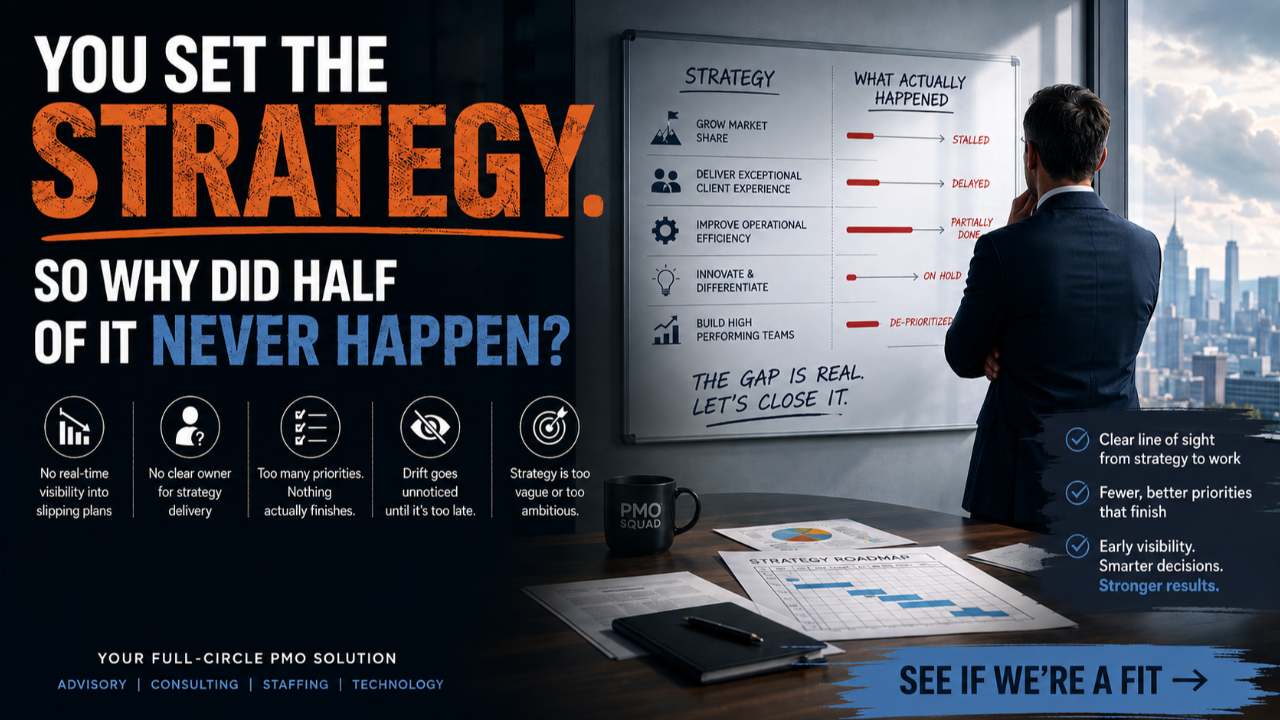
It's a familiar moment for a lot of executive teams: the annual strategy is set, the deck looks great, everyone nods in the room — and twelve months later, someone asks what happened to half of it. No one has a clean answer. It didn't fail loudly. It just... drifted.
If that sounds familiar, you're not alone, and you're not imagining it. Here's what that drift usually looks like from the inside:
-
Annual plans that quietly disappear by Q3, with no one flagging the slip in real time.
-
Initiatives that never had a clear owner or a real end date to begin with.
-
A strategy deck that, if you're honest, doesn't match what teams are actually spending their time on.
None of that is a coincidence. It's usually a symptom of one (or several) of these:
-
No line of sight from the strategy to the actual work — the connection exists on paper, not in practice.
-
No real prioritization or governance, so nothing ever fully finishes; everything is "in progress" forever.
-
No one owns delivery of the strategy itself. Plenty of people own pieces of work. No one owns whether the strategy happens.
-
Progress isn't tracked in a way that surfaces drift early — so the gap is invisible until it's too late to close.
-
The strategy was too vague or too ambitious to ever translate into a workable plan.
I'm curious whether any of that sounds familiar.
This isn't an unusual pattern. One widely cited academic review of strategy-execution research — a 2015 analysis in the Journal of Management & Organization — put the average failure rate at roughly 50%, meaning something close to half of strategic initiatives never get delivered as planned. If your year looked like that, you're squarely in the norm, not the exception.
The Questions Worth Asking Yourself
Before assuming this is a "strategy problem," it's worth getting specific. A few questions tend to surface where things are actually breaking down:
-
Can you trace each active initiative back to a specific strategic objective?
-
Who owns making the strategy happen — not a piece of it, the whole thing?
-
How, and when, do you actually learn that something's off track?
-
Did your team decide what to stop doing, or did the new priorities just get added on top of the old ones?
If those questions are hard to answer quickly, that's usually the tell.
What This Actually Costs
This isn't just a planning inconvenience. It's worth naming the real cost:
-
What has slipping strategy already cost — missed market windows, wasted spend, momentum that has to be rebuilt from scratch?
-
What does another year like the last one cost, specifically?
-
How is this landing with the board, and how many more cycles of "we'll tighten it up next year" is that conversation good for?
What Good Actually Looks Like
Organizations that have solved this don't necessarily have a fancier strategy. They have a visible line from strategy to delivery — you can point to any initiative on the roadmap and name the objective it serves, and vice versa. They run fewer, better-funded priorities that actually finish, instead of a long list where everything moves a little and nothing lands. And when something starts to drift, they know early — not at the year-end retro.
Worth Naming: What This Isn't
This particular issue is often confused with a few related but distinct problems — everything being labeled priority #1, a PMO that isn't delivering, or a transformation effort stalling at scale. Those are real, but they're not quite this. This one is specifically about the gap between what got decided and what got done.
And to be direct: if what you're really looking for is a better-looking plan on paper — not the discipline to actually execute against it, or the executive backing to enforce trade-offs when priorities collide — this probably isn't the right conversation yet.
Why This Is Different From "Just Manage It Better"
Most attempts to fix this add another status meeting or another tracking spreadsheet — and the drift comes right back the next cycle, because nothing structural changed. Project and PMO delivery is the only thing we do, which means our starting point isn't a generic change-management framework — it's building the actual line of sight between your strategic objectives and the initiatives funded to deliver them, and naming a single owner for the strategy's delivery, not just its parts. That's a different kind of fix than a better dashboard.
If This Sounds Like Where You Are
We're not always the right fit, and we'd rather figure that out early than waste your time. But if the gap between your strategy and your delivery is costing you real time, money, or credibility with the board, it's worth a conversation to understand what's actually happening before deciding whether — or how — to fix it.
Follow Us on LinkedIn