
Your PMO isn't the problem
Jun 24, 2026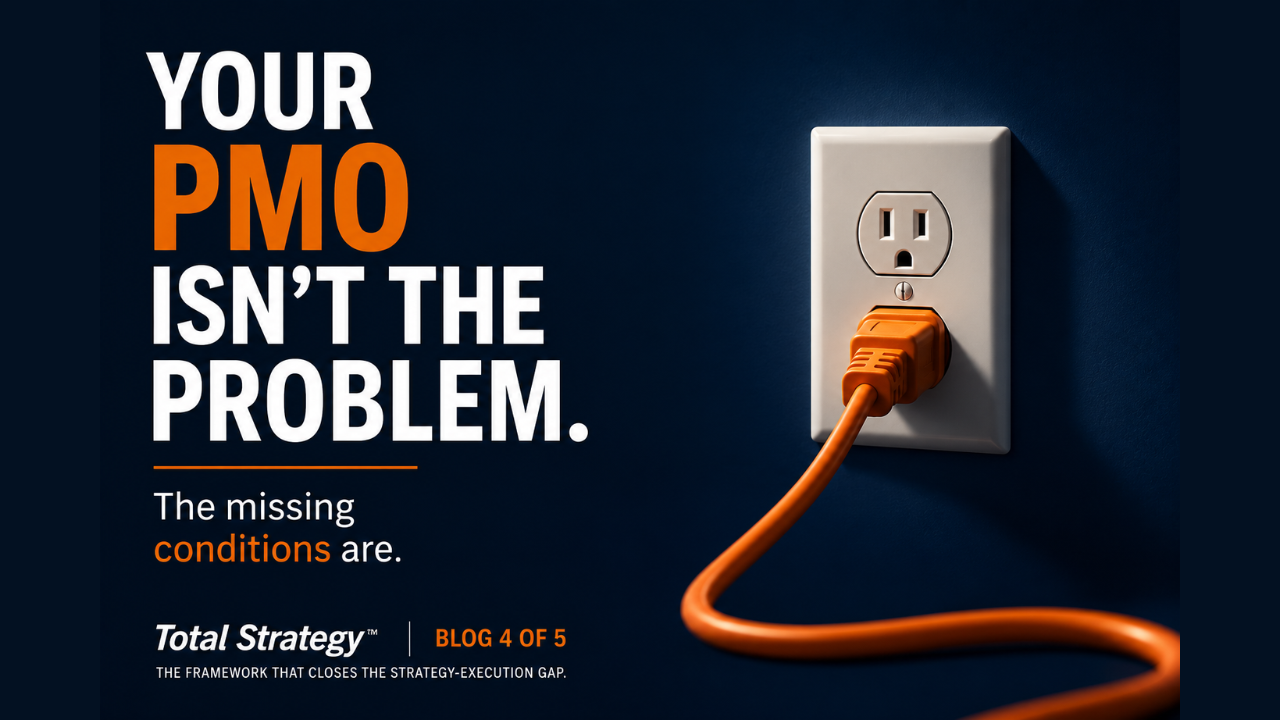
In the first article of this series I said something in passing that deserves its own article. The PMO, the Transformation Office, the Strategy Realization Office: different names, same construct, each living inside an organization that lacks the infrastructure to deliver strategy.
This is that article. I’m PMO Joe, I run a PMO consulting firm, I’ve made my career living in the PMO community so believe me when I say this is not an attack on PMOs. Some of the best professionals I know run them. It is an explanation of why even the good ones keep failing. The failure is built in on day one: accountability for delivery, without the structures that make delivery possible.
Here is the standard origin story. The executive team has invested to fix delivery capability. The leaders, the managers, the employees all feel the Gap. Strategy is not landing, initiatives are stalling, nobody can say why. So they stand up the new or latest construct, whatever name it gets this time, and they hand it accountability for delivery. Then they go back to running the business.
Our own research has been tracking this cycle for years. In The PMO Squad's 2022 study, 43 percent of PMO leaders rated their PMO as successful. By 2024 that number had climbed to 61 percent. Real improvement, and I am proud of this community for it. In that same 2024 study, 70 percent still had no formal process to measure PMO value, 62 percent named measuring value as their top challenge, and among PMOs without executive support, 93 percent said their executives do not understand the value of the PMO. Read those together and you get the pattern this whole article is about. PMOs are getting better at being PMOs. But better PMO work does not close the Strategy-Execution Gap, because the Gap was never inside the PMO.
And we did not stop at surveys. We tested the proposition directly. We built a simulation: 10,000 organizations per population, identical starting conditions, identical engine, identical 36 months. Three populations. Organizations with no framework at all. Organizations faithfully enacting a respected PMO framework, doing everything it prescribes, as written. And organizations using Total Strategy. That’s the tease, the results I’ll share later in the article after you understand Total Strategy Disciplines and Capabilities.
The organization handed one team accountability for outcomes that depend on conditions the team does not control. The PMO does not control whether strategic work gets protected when a customer emergency hits. It does not control whether intake keeps operational work out of the strategic portfolio. It does not control whether bad news is safe to speak, whether decisions can be made at the level of the work, or whether the strategy survives translation through four layers of management. The PMO was given the accountability and none of the conditions. Then, when delivery does not improve, the PMO gets reorganized, renamed, or removed, and the cycle starts again.
I personally lived this story early in my career before starting The PMO Squad. I was recruited to come in as the new PMO Leader and improve the PMO. I was given freedom to make personnel decisions, invest in technology, write our methodology and implement new organizational processes. I built a high functioning PMO that remained outside the structure of the broader organization and over time we suffered the same fate as my predecessor.
I want to be precise about the lesson here, because it is easy to take the wrong one. The lesson is not that PMOs are bad. The lesson is that no team, whatever you call it, can close the Strategy-Execution Gap from inside a structure that was not built to close it. The Gap is three-dimensional. It lives across functions, down the altitudes, and over time. A single office sitting in one place on the org chart cannot reach all three dimensions, no matter how talented its people are.
The story I use to paint this visual is an extension cord compared to a wall outlet. The extension cord provides power and can reach areas the outlet can’t. However, the extension cord can’t carry the same load as the outlet. The extension cord can be removed when the person leaves that office. The extension cord is not connected to the backup generator nor the electrical grid. The outlet is infrastructure and the extension cord is temporary.
This is exactly why Total Strategy is infrastructure and not an org design. And it is why I am careful about something that may surprise you. The framework does not tell you which boxes to draw on your org chart. It does not name the positions you must create or the reporting lines you must use. That is deliberate.
Think about what infrastructure actually specifies. Financial controls do not dictate your org chart either. They specify what must be true: transactions are authorized, duties are separated, records are auditable. How you structure the team that makes those things true is your call, and it looks different in a bank than in a fifty-person nonprofit. The control framework defines the conditions. The organization designs itself.
Total Strategy works the same way. It defines what must exist for strategy to execute reliably, and it names those structures precisely. These are the Disciplines and Capabilities I promised in the last article, and they belong here, in the diagnosis. Two foundations: Systems create conditions, People create outcomes. Six disciplines across them.
On the Systems side: Total Strategy Architecture, the mandate and authority that make strategic delivery legitimate. Strategic Focus, the intake and protection that keep operational urgency from consuming strategic work. Total Strategy Intelligence, the visibility that tells the truth about what is actually happening.
On the People side: Organizational Safety, so bad news travels fast enough to act on. Execution Excellence, so delivery is a profession rather than an act of heroism. Strategic Identity, so the capability survives the next leadership transition.
Now read that list again as an autopsy of the failed PMO. Every discipline names something it was never given. No mandate, so its authority was contested at every turn. No protected intake, so the portfolio flooded with operational work. No trusted intelligence, so its reports were filtered narratives nobody believed. No safety, so problems surfaced too late to fix. No profession, so its best people burned out carrying what the system should have carried. No identity, so the next reorganization erased it. The PMO did not fail at its job. The structures that would have made the job possible were absent.
Within Total Strategy, underneath the six disciplines sit 37 specific capabilities, each one assessable as absent, partial, or present in your organization. That is what makes this infrastructure rather than philosophy: it is inspectable. You can audit your financial controls. You can audit your strategic delivery capability the same way, capability by capability, no vibes. And here is the part that follows from everything in this series so far. Those structures are non-negotiable. Who holds them, what the roles are called, and where they sit on your chart is yours to decide. Your organization knows its own structure, politics, and talent far better than any framework ever could.
This distinction matters because the alternative is what you have already lived. Every methodology that arrived with a predefined org chart asked your organization to bend itself around the methodology. Some bent. Most snapped back the moment the consultants left. Infrastructure that survives is infrastructure the organization shaped to fit itself, against conditions that do not bend.
About the results of the simulation.
|
Population |
What they did |
Reached Execution at Scale |
|
No framework |
Invested the way most organizations operate |
0.25% |
|
Respected PMO framework |
Everything the framework prescribes, faithfully enacted, as written |
1.4% |
|
Total Strategy |
Built deliberately, structurally |
67.8% |
Simulation: N=10,000 per population, identical baseline, engine, and 36-month horizon. The PMO framework figure is its most generous boundary; on stricter authority assumptions it is indistinguishable from no framework. Model-based, pending validation against benchmark data.
The simulation supports our primary assumption: PMOs can improve and still not consistently deliver strategy. Total Strategy was designed to solve a different problem. Rather than improving the PMO, it creates the structures and conditions required to consistently deliver strategy across the organization. The PMO was never the problem. The missing conditions were.
Here is what I offer to my PMO community and peers as well as every executive who oversees one. Stop asking whether your PMO is performing. Start asking whether the conditions for delivery exist in your organization at all. If they do not, no PMO can succeed, and replacing the leader will not change that. If they do, your PMO might be the best-positioned team in the company to operate the infrastructure. The audit question is not about the office. It is about the conditions.
That question, whether the conditions exist, is answerable. It is exactly what the assessment behind this framework measures, capability by capability. And it is also the question behind the final piece in this series, because the honest answer is that nobody yet knows how organizations worldwide actually stand against these conditions. We intend to find out, and I am going to ask for your help doing it.
Don't audit the office. Audit the conditions.
The full architecture, all six disciplines and 37 capabilities, is on The PMO Squad website.
Follow Us on LinkedIn