Your Strategy Probably Isn't The Problem
Jun 12, 2026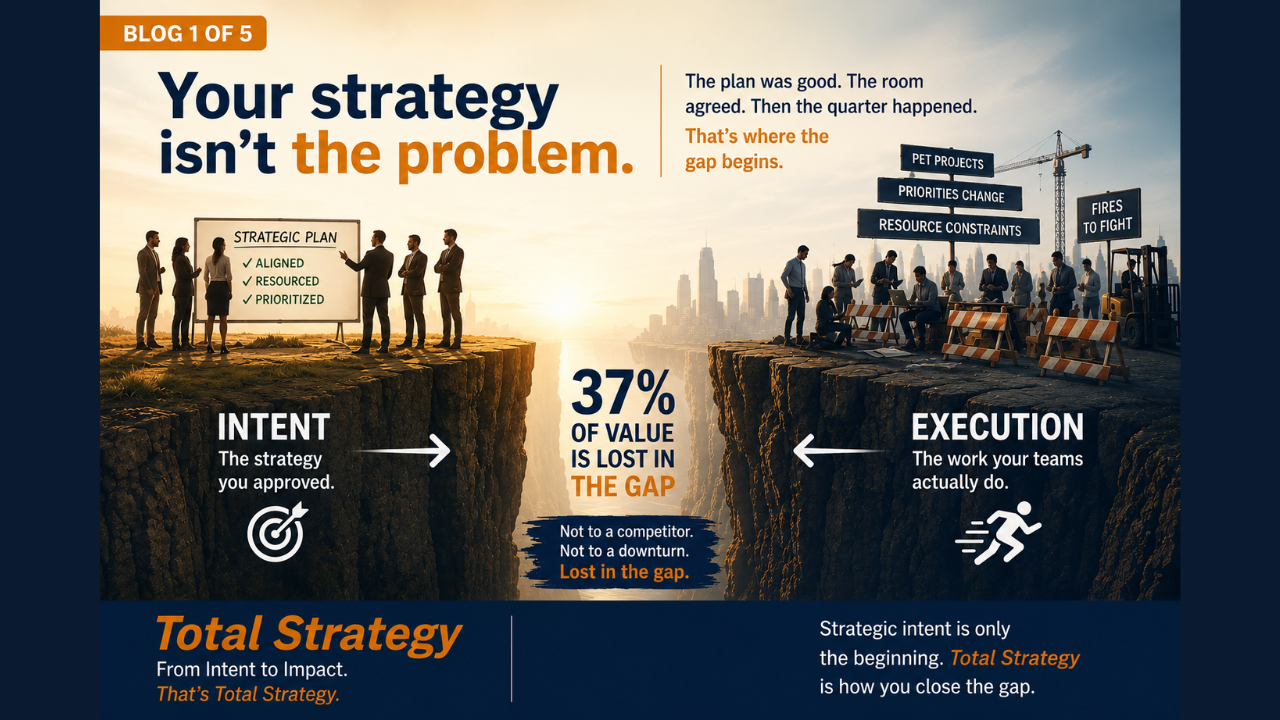
You left the offsite aligned and energized. A week later everyone was back to defending their turf.
Every organization I know has lived some version of that sentence. The plan was good. The room agreed. Then the quarter happened, and the strategy you committed to and the work your teams actually did slowly drifted apart. There was no single moment where it broke. It just drifted. That drift may be causing your organization to lose almost 40% of the value you seek to deliver in your Strategic Plan.
We were working with a healthcare client several years ago. The Executive team worked for months on a new Strategic Plan. The plan was supported by resource needs, financial estimates, allocations for Operations. It was a well-thought-out plan for the Health Care System. Then it all started to come apart. Our team was supporting delivery and I noticed the creep start with promised resources that never got onboarded. Then Strategic Initiatives were pushed aside for pet projects by middle managers. Portfolio decisions weren’t aligned to delivering on the original plans, rather solving the current crisis. In an executive session I questioned the decisions and activities of the team only to be told the functional leaders had the authority to override the decisions made during the Strategic Planning sessions. What?!?
I have spent 25 years watching this happen. For a long time, I thought I was looking at different problems. A weak PMO at one client. A planning process that never stuck at another. A transformation office that transformed nothing. Eventually I saw it. This was one problem showing up in different costumes.
The cost of that one problem has been researched and measured. Michael Mankins and Richard Steele surveyed nearly 200 companies for Harvard Business Review and found that organizations deliver only about 63 percent of the financial value their strategies promise. The other 37 percent is lost between deciding the strategy and delivering it. Not to a competitor. Not to a downturn. Lost in the gap, the Strategy-Execution Gap to be precise. Their article is called “Turning Great Strategy into Great Performance,” and it should be required reading for every leadership team.
Most leadership teams never see the 37 percent leave. There is no line item for it. It walks out one stalled initiative at a time, one reassigned person at a time, until the year just looks slow and nobody can say exactly why.
You already know what the leak sounds like from the inside. Everyone is busting it and nothing strategic gets done. The dashboards are green but nothing feels green. The same two people play hero on every initiative that matters. You hired the consultants, bought the software, ran the program, and the needle never moved. Not one of those is a strategy problem. Every one of them is what happens to a good strategy after the planning ends.
A few years ago, a large consumer goods company brought us in to improve their PMO. They had used a well-respected large global firm to build the original PMO as part of an overall organizational initiative to improve delivery. We discovered plenty of good stuff, but it was more “good in theory, short in practice”. It wasn’t wrong, but it wasn’t right for this organization. The company had invested close to $1 million in the effort but wasn’t seeing results. Projects were still pretty much working the same as they always had. Resource Management was still a problem. Portfolio decisions were still being ignored, and employees were frustrated that everything changed but nothing got better. I remember talking to the CEO and he said, “yes, we’ve gotten better but we’re just better at not being good enough.”
For years the standard answer was to fix the pieces. Tighten the PMO. Re-run the offsite. Buy a better tool. Stand up an office. Each fix treats a symptom, which is exactly why the symptoms keep coming back. The real issue sits underneath all of them. Strategy and execution drift apart because nothing in the organization is built to hold them together. Not a methodology. Not a dashboard. Not a person willing to play hero one more time. Holding strategy and execution together is structural work, and most organizations have no structure that does it.
That is the gap I set out to close, and it is where this body of work began.
It began under a different name. I called it Organizational Project Delivery, and OPD got the core idea right. Organizations close this gap by building capability together, across every function, not by fixing one box on the org chart. That idea held up everywhere I tested it. What changed was my understanding of the size of the problem. This was never about projects. It was about the full distance between what an organization decides to do and what it actually gets done. The work needed a name as big as the problem it solves.
OPD evolved into something more significant. What began as a framework for improving delivery became a framework for closing the distance between strategic intent and organizational outcomes. That evolution became Total Strategy.
The name carries the whole argument. Most organizations believe that once the plan is approved, the strategy exists but it doesn’t. A plan is a statement of intent. The strategy only becomes real in what gets delivered, and the gap between intent and delivery is exactly where the 37 percent lives.
Creating your strategic plan is Partial Strategy.
Delivering it is Total Strategy.
That is not wordplay. It is the difference between an organization that has decided what it wants and one that is built to get it. The difference between settling for 63 percent and going after the rest. Strategy execution has never had a home inside the organization. Some say the PMO others build a Transformation Office or maybe a Strategy Realization Office. Each of these is essentially the same construct, a PMO with differing names, each living within an organization lacking the infrastructure to deliver strategy. There isn’t a place where the work of turning strategic intent into outcome lives, gets owned, and holds up under pressure. That is what Total Strategy is built to be.
Over the next several articles I am going to break this down into proper granularity. What surprised me most was discovering a three-dimensional Gap, not just a single challenge to overcome. What it takes to close it, and why the answer is infrastructure rather than another initiative. At the end, I will share what we are learning about how organizations everywhere perform against this gap, and how you can help us measure it.
For now, one ask. Think back over the past several years and count how many of those symptoms you have said out loud or heard in your own leadership meetings. That number is your first read on how much of your strategy leaks after the plan is done.
The question isn’t whether your Strategy is good enough. The question is whether your organization is built to deliver it.
See where your organization sits in the gap. The walkthrough and a short diagnostic are here: thepmosquad.com/total-strategy
Follow Us on LinkedIn