
The Strategy - Execution Gap is Real, and we finally have the data to understand it.
Nov 04, 2026
The gap is still open
The strategy is clear. The initiatives behind it keep stalling. Teams are busy, yet leaders can’t see how the work connects to strategic objectives. The year ends with important commitments unfinished and no shared explanation for what happened.
If that sounds familiar, your organization has plenty of company.
This week, The PMO Squad released The State of Strategy Execution 2026 Report, our first annual global survey of how organizations turn strategy into results.
The headline: 82% say the Strategy-Execution Gap is still open in their organization. The number jumps to 90% in organizations with over 1,000 employees. Only 17.6% describe strategy delivery as a reliable organizational capability that survives leadership changes.
We ran this research because experience told us the gap was real, but couldn’t tell us how widely it was shared. Any firm that advises on strategy delivery risks building its understanding from the companies that call it. We wanted a broader view—and a baseline we can return to each year to see what changes.
A great deal of action, less evidence of arrival
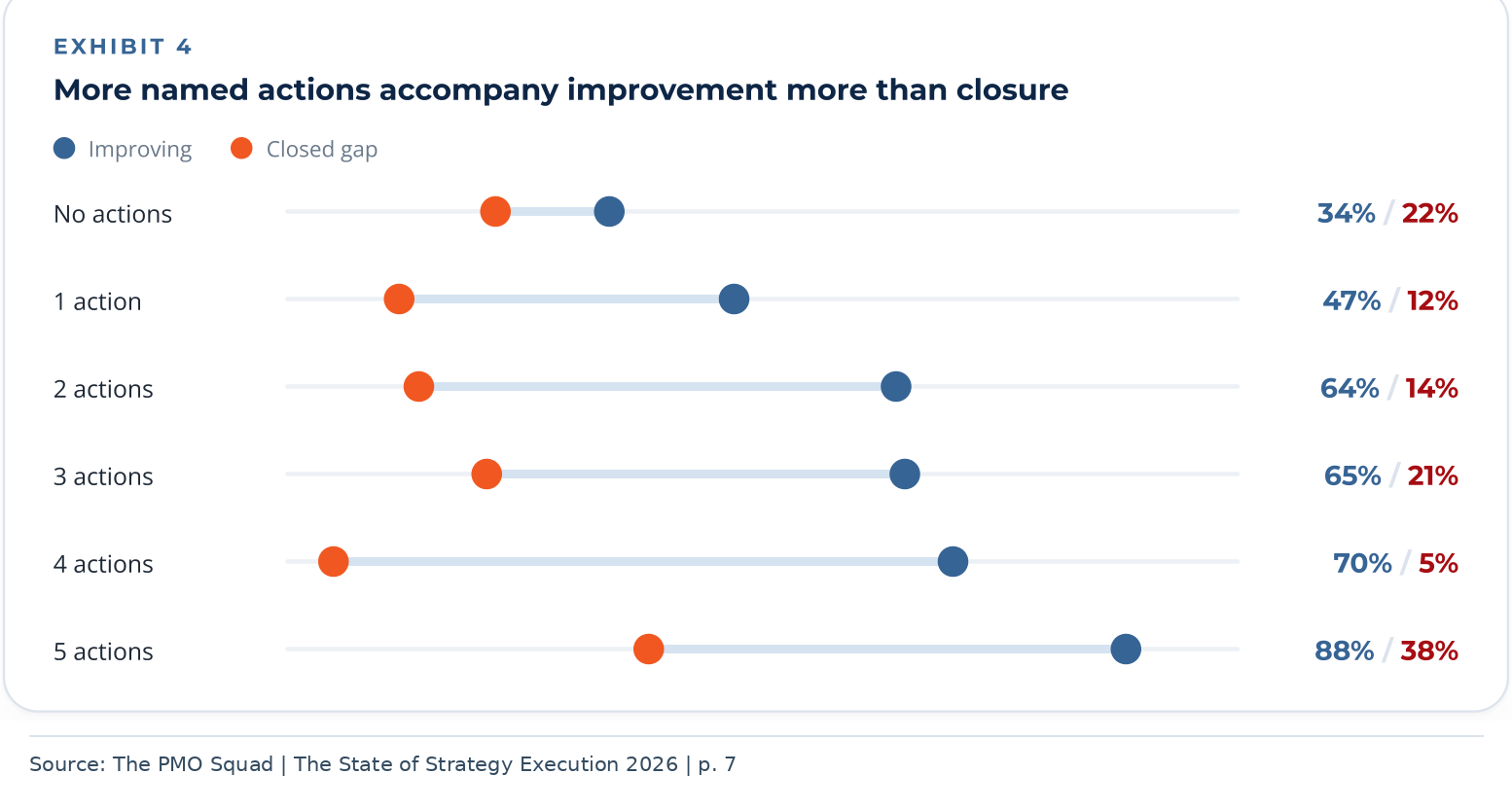
This is not a story about organizations standing still. 63% reported a deliberate attempt to close the gap. The most common moves were building or restructuring a PMO or delivery function (54%), adopting a delivery method or framework (52%), and investing in portfolio or project tooling (36%). More action was associated with more reported improvement: 34% among respondents who named no actions, rising to 70% among those who named four. But closing the gap did not follow the same climb. Among those four-action organizations, just 5% described the gap as closed.
The gap also persists. More than a third of open-gap respondents (36%) have been in that condition for three or more years and reported no improvement in the past year.
Respondents identified three places where the gap shows up:
-
Across time (40% selected): Operational urgency keeps crowding strategy out. Among this group, 17% described the gap as closed.
-
Across levels (37%): Strategic decisions get made without the people running the work. Among this group, 9% described the gap as closed.
-
Across functions (24%): Coordination across departments breaks down. Among this group, 19% described the gap as closed.
Organizations are taking action. Far fewer report that strategy delivery has become reliable.
What holds when a real priority is tested
Respondents rated six foundations of strategic delivery: recognized authority, protected priorities, straight answers on status, honest information, lasting delivery talent, and a written commitment to delivering strategy. Each was rated Absent, Partial, or Present.
Partial was the most common rating on all six, and 48% rated none fully Present.
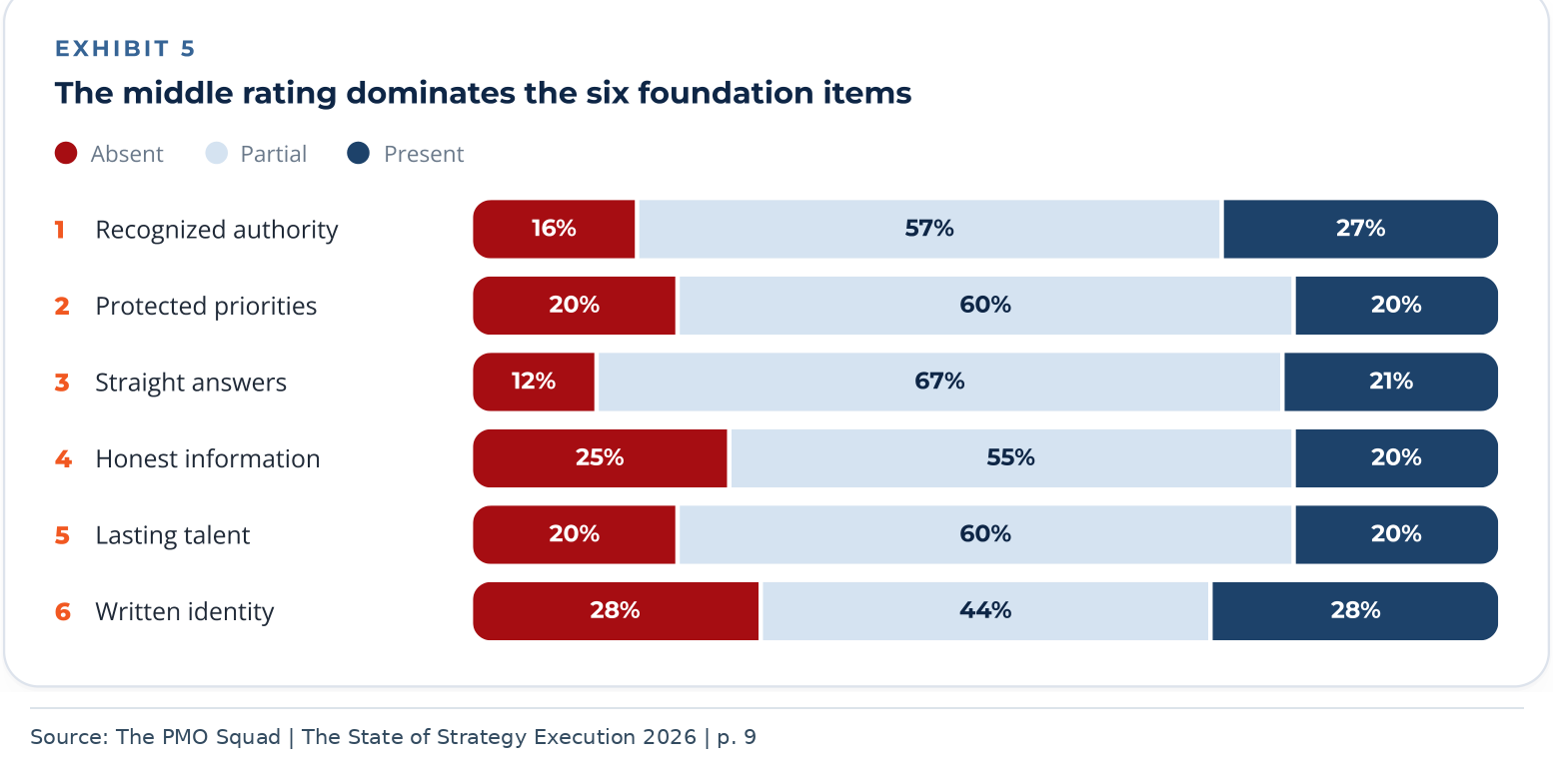
Partial is an easy condition to mistake for success. Among organizations that rated all six foundations Partial, 77% had made a deliberate investment and 68% reported improvement. Only 9% described the gap as closed.
Three patterns stood out:
-
Missing foundations were associated with an open gap. Where one or two foundations were Absent, 5% reported a closed gap. Where none were Absent and at least four were Present, 74% did. That second group was small—23 respondents—but the contrast was substantial.
-
Leadership behavior under pressure mattered. Where leaders treated operations and strategy as a forced choice, 27% reported improvement and none reported a closed gap. Where leaders kept both funded and staffed, even in a tough quarter, 84% reported improvement.
-
Authority and protected priorities stood out together. Where strategic work had recognized authority across the company and a protected place on the strategic priority list, 70% reported a closed gap. Across all other combinations of those two foundations, 6% did.
The finding we didn’t want, and published anyway
PMO and project delivery is all we do, so this finding is uncomfortable for us: organizations that built or restructured a delivery function often answered much like those that had not.
The difference was authority.
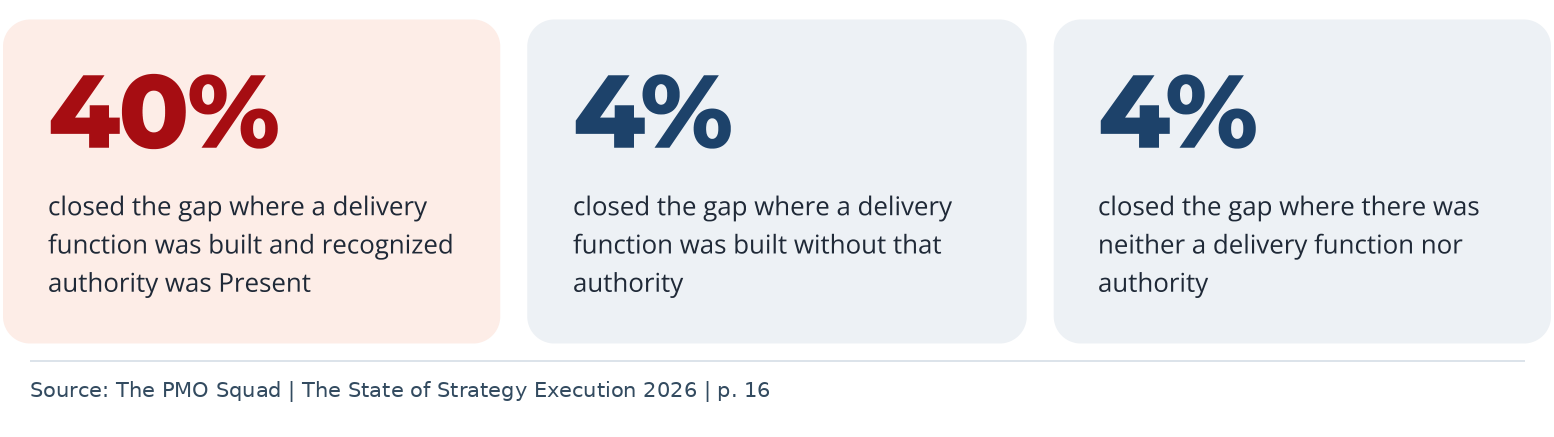
Where a delivery function had been built and recognized authority was Present, 40% reported a closed gap. Where a function had been built without that authority, 4% did—the same rate as organizations with neither.
A delivery lead can run the cadence, the reporting, and the portfolio view, and still lose every argument with a department head who says no.
We’ve tried to be equally direct about the research itself. The PMO Squad sponsors the study, and our Total Strategy framework shaped some of its questions. This is a voluntary, non-probability sample, not a random draw of businesses. The report shows how one response-quality screen moves the open-gap figure from 82% to 89%, and explains what we’re changing for Year 2.
As Joe Pusz puts it in the introduction, a first year is a photograph, not a film.
Put the report to work
The report closes with seven questions for executives and delivery leaders. Bring them to your next leadership meeting. Have each person answer independently, using the same recent tough quarter as a reference. Rate each foundation Absent, Partial, or Present, and back each answer with a real decision.
The places where answers differ are where the useful conversation starts.
One question to begin with: Who owns closing the Strategy-Execution Gap in your organization?
If the answer is a committee with no accountable leader, a function without authority, or nobody, ownership needs a closer look.
Download The State of Strategy Execution 2026
We don’t know whether your organization looks like these findings, and we may not be the right fit for what you’re facing. But if a lot of movement and not enough arrival sounds familiar, let’s talk through what you’re seeing and find out together whether it’s something we can help solve.
Are PMO Challenges Costing You Time and Money?
Follow Us on LinkedIn