
What is the State of Strategy Execution?
Jul 07, 2026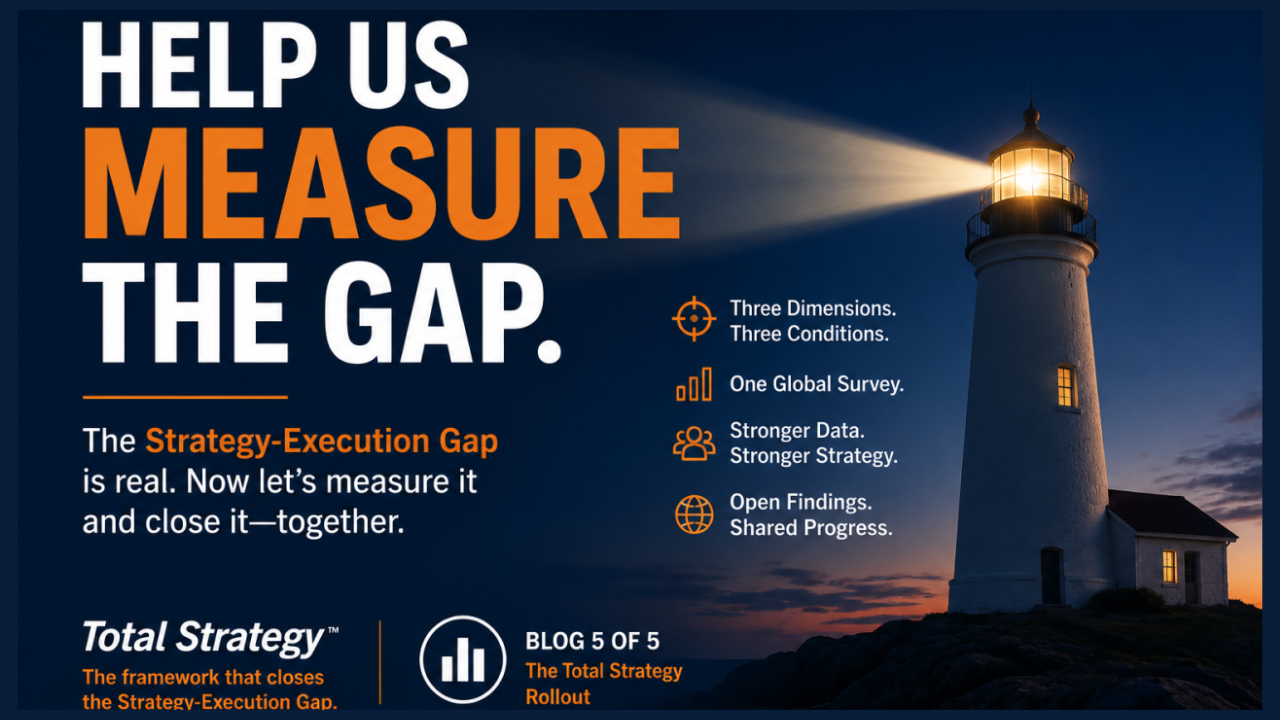
Over the past four articles I have walked you through an argument. Your strategy is not the problem; the value leaks out through the Strategy-Execution Gap, and research puts the leak at 37 percent. The Gap is specific: three dimensions, three organizational conditions. Closing it takes infrastructure, not another initiative. And no single office can close it alone, because the Gap is bigger than any office.
This last article is different. I am not going to teach you or preach to you anything today. I am going to admit what we do not know, and ask you to help us find out.
Here is the honest state of the evidence. We know the gap is real and expensive. The research base is solid: Mankins and Steele measured the 37 percent value loss across nearly 200 companies. Bain has shown that the overwhelming majority of business transformations fail to deliver their targets. A decade-long study published in Harvard Business Review found that roughly two thirds of large organizations struggle to execute their strategies. The problem is established beyond argument.
Here is what nobody has measured. Which of the underlying conditions for delivery are actually absent, partial, or present inside organizations, and how does that pattern differ between the companies that deliver their strategies and the companies that do not? The failure rates are documented. The structural reasons behind them have never been benchmarked at scale. Everyone in this field, including me, has been working from experience, pattern recognition, and client samples too small to generalize.
I have lived inside the Strategy-Execution Gap for my entire career. For years I saw the patterns but had no reliable way to measure them. Building Total Strategy was the first step. Testing it, refining it, and improving it with data is what comes next.
That is what the 2026 State of Strategy Execution Global Survey is built to change. It is a twenty-question instrument, about ten to fifteen minutes, that reads the foundational conditions of strategic delivery in your organization: which exist, which are partial, which are missing entirely, alongside where you sit in the gap and what your organization has already tried. It runs annually, so over time it will show not just where organizations stand but which conditions move and what moving them changes.
The findings will be published in the State of Strategy Execution Report, which will be released in October, openly. Not gated behind a sales funnel. The entire point is to build an evidence base this field has never had, and an evidence base only works if everyone can see it.
Two things make this survey worth your ten minutes when most surveys are not. First, you now speak the language. If you have read this series, you know what the dimensions and conditions mean, which makes your answers sharper than a cold respondent guessing at jargon. Second, this is not a survey about job titles and tool preferences. Every question maps to a specific structural condition in the framework, which means every answer becomes usable evidence about how organizations actually deliver strategy, or fail to.
I will be straight with you about who we need. Past research in this space, ours included, has been answered mostly by PMO and delivery leaders. That voice matters and we want it. But the picture only completes when executives answer too, because the gap looks different from the top of the organization than it does from the middle. If you are a CEO, COO, or business unit leader, your ten minutes are the rarest data in the set. And if you are a delivery leader, the single most valuable thing you can do beyond taking it yourself is to put it in front of one executive in your organization.
Our 2024 research, drawn from more than 160 project leaders, suggested that 7% of organizations had reached Execution at Scale. Even then, I suspected the number was too high. The difference now is that we finally have a way to test it.
Here is my commitment in return. Every respondent gets the published findings. The methodology will be transparent, including response counts, so you can judge the conclusions for yourself. And the results will feed back into the framework itself. If the data says a condition matters more or less than we believed, the framework changes. That is what it means to be evidence-grounded rather than opinion-grounded, and it is the standard this field should have been held to all along.
Five articles ago I told you that your strategy is not the problem. Everything since has been about what is: the gap, its shape, the infrastructure that closes it, and the conditions no single office can create alone. Now you know what we know. Help us learn the rest.
Creating your strategic plan is Partial Strategy. Delivering it is Total Strategy.
Take the State of Strategy Execution Global Survey — ten to fifteen minutes, findings published openly.
Follow Us on LinkedIn