Standing Up a PMO From Scratch? Don't Start With a Template.
Aug 12, 2026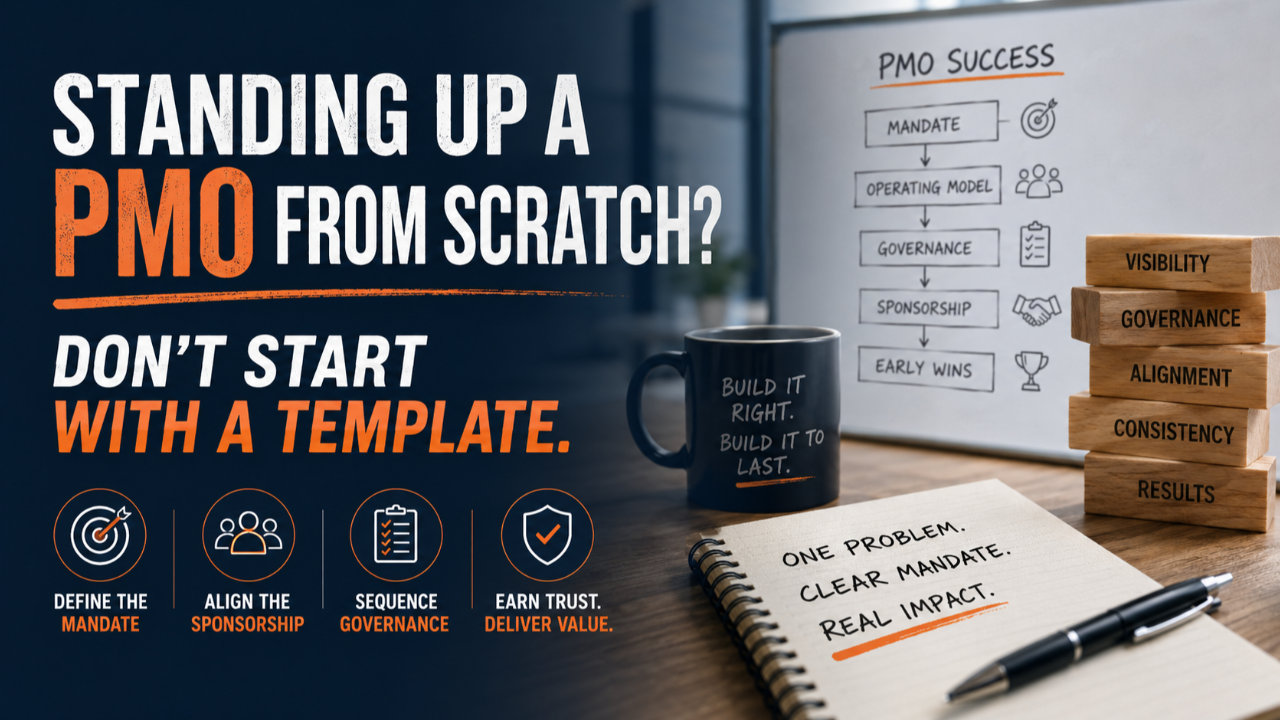
Somewhere in your organization, someone just got a mandate: "Go build us a PMO."
No charter. No org chart precedent. Just a directive, a blank slate, and an expectation that this new function will somehow fix the project chaos everyone's been living with.
If that's you right now, here's what we usually see happening underneath the surface:
Leadership has decided a PMO needs to exist, but nobody has clearly defined the one problem it's supposed to solve. The person handed the assignment has authority in name only — no real mandate, no agreed operating model, no answer for how much say this PMO will actually have over how projects run. And in the meantime, that person is drowning in competing advice: three different frameworks, five vendor templates, and a dozen LinkedIn opinions about what a "real" PMO looks like.
I don't know if any of that sounds familiar. But if it does, it's worth pausing before you build anything.
Why "blank slate" is the most dangerous starting point
A new PMO with no defined mandate isn't neutral — it's exposed. Without agreement on what problem it exists to solve, everyone fills in their own answer: finance wants cost control, ops wants status reports, the CEO wants visibility, and the PMO ends up trying to be all of it at once. That's usually the fastest path to a PMO that gets cut in eighteen months for "not delivering value" — when the real issue was that value was never defined.
Before you stand up a single process, it's worth asking a harder question: what's riding on this PMO's early credibility? A function that starts strong earns the room to grow. A function that starts fuzzy spends its first year defending its own existence instead of doing the work.
What has to get decided before anything else
A PMO built to last — not built to be cut — usually gets four things settled up front, in this order:
-
Mandate. The one problem this PMO must solve in year one. Not five problems. One.
-
Operating model. Supportive, controlling, or directive — how much authority it actually has over how projects run, not how much authority people assume it has.
-
Governance, sequenced. Which processes go live first, and which ones wait until the PMO has earned trust.
-
Sponsorship. Who the PMO reports to, and what that sponsor actually expects it to deliver.
Skip any of these, and the PMO inherits someone else's confusion about what it's for.
What good looks like
For a new PMO, "good" isn't a fully built-out governance suite in month one. It's a signed charter naming the one problem the PMO owns, an operating model matched to the organization's actual appetite for authority, a named sponsor with agreed expectations, and one or two early wins delivered before the PMO tries to expand its scope. That's the difference between a PMO that gets referenced in next year's strategy conversation and one that gets quietly dissolved when budgets tighten.
This is also, deliberately, not something we improvise per client. Building PMOs — and only PMOs — is what we do all day, every day, which is why a discovery-to-charter path exists rather than a blank page. The design work still bends to your organization; the sequence doesn't have to be reinvented from scratch.
It's rarely a one-person decision
The executive sponsor, the leaders whose work the PMO will touch, and the person who'll actually run it day to day all need to be in the room for these decisions — not just the person who received the mandate. A PMO designed in isolation, without the leaders it will govern, tends to meet resistance the moment it goes live.
Where this isn't the right fit
If what you're really looking for is a template to fill in — a generic PMO-in-a-box — that's not what this is. And if there's no sponsor or real authority behind the mandate, no outside design work will manufacture credibility that leadership hasn't granted. Those are honest disqualifiers, not sales objections.
If this is where you are
The cost of getting this wrong isn't just wasted setup time — it's a PMO that spends its whole life justifying itself instead of delivering. If you're standing up a PMO from scratch and want a proven path instead of trial and error, that's a conversation worth having before you write a single process document.
Let's talk through where you actually are, and figure out together whether we're the right people to help you get it right the first time. Contact us today!
Follow Us on LinkedIn